• Home
  • Portfolio
  • JOUR 4932
  • JOUR 1550
Alec Brooks

The journalist as referee

9/25/2012

0 Comments

 
Picture
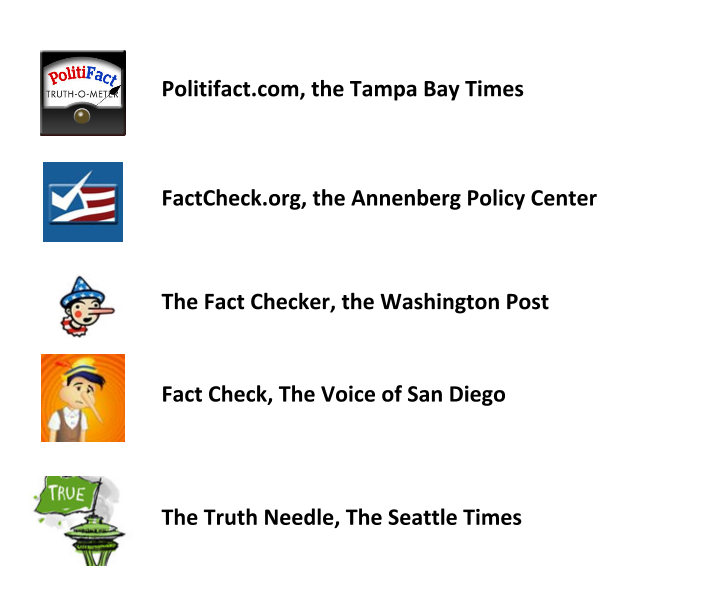
Fact-checking sites are run by various media outlets and one research center. (Graphic by Alec Brooks)
No, I haven't transfered to Herbert Lowe's other class, Sports Journalism.

I'm referring to Bill Adair's apt analogy that when it comes to fact-checking, journalists are making a call — they are explicitly saying if something is true or not. Adair, the editor of Politifact, was speaking in a Poynter Webinar that I watched for my journalism class.

Making these "calls" unambiguous is where a rating system shines. The Truth-O-Meter's six distinct categories — True, Mostly True, Half-True, Mostly False, False and Pants On Fire — makes the fact-checker's judgement clear. Even if readers are confused by some of the intermediate steps that went into checking a claim, they will still get the overall picture.

Ultimately, I think this is a valuable service for journalists to provide. If someone claims something that can be checked, journalists should absolutely do the legwork needed to verify or debunk it. 

I'm reminded of the flap over a column by Arthur Brisbane, former public editor of The New York Times. In it, he asks whether reporters should call out lies and errors as they report them. For many journalists, the answer was 'Duh,' as Poynter blogger Chris Silverman documented.

Brisbane did have some valid points. There are pitfalls we need to watch out for. Does it make sense to call out every lie as we see them, considering how long a typical factcheck is? We can abridge them, but that might not do the claim justice. Also, there's a very real need to make sure we aren't hounding one side while letting the other side get away with worse lies.

And yet, we have to avoid suggesting a false equivalence. Sometimes the evidence is uneven. If one politician's speech is flat out wrong, I want to know that. I still want to if the publication would appear biased in the short run. 

I think Adair has a sensible philosophy for avoiding false equivalence. Just don't try and keep track of which side has been rated more often. He acknowledged the need to occasionally make sure it hasn't gone completely out of whack, but evenness is not a big concern. After all, referees don't add up the penalties for both sides to make sure it comes out even. If one team fouls more, they will get more penalties.

Adair presented Politifact's techniques straightforwardly and provided plenty of practical information. Even if you aren't interested in the methods, the results are a must-read for every journalist and voter.
0 Comments

Ann Romney battles bad Wis. numbers

9/25/2012

0 Comments

 
Picture
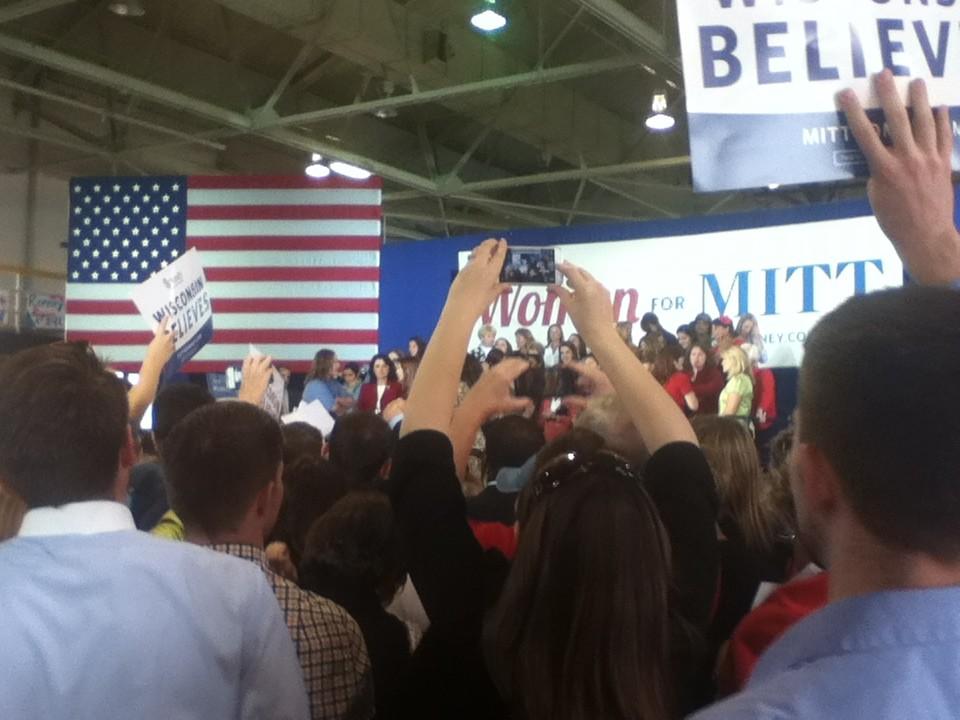
People await a chance to see Ann Romney up close. (Photo by Alec Brooks)
In lieu of class Thursday, we went to Ann Romney's rally at Marquette's Old Gym. Besides Romney, a number of other Republican women spoke, including state Sens. Alberta Darling and Leah Vukmir and Lt. Gov. Rebecca Kleefisch.

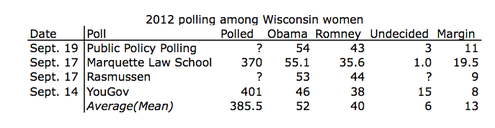
As my colleague Joe Kvartunas pointed out on Twitter, Mitt Romney's numbers in Wisconsin aren't all that good. Besides the Public Policy Polling poll he referenced, NBC News/Marist and the Marquette Law School polls have bad news for Romney across the board and particularly among women.

I've summarized recent polls of Wisconsin voters that include a gender breakdown in a table below. On average, Romney is behind by 13 points.
Picture
As Melanie Lawder pointed out on her blog post, Ann Romney focused intensely on attracting women voters. (If you need further convincing, check out the banner in the photo above.)

She also was concerned about showing Mitt Romney as a human figure. I think she said "Mitt cares" or something very similar about half a dozen times. It seems the Romney campaign is responding to criticism that Mitt Romney is aloof and uncaring.

Even if you ignore Mitt Romney's numbers among women, he's not doing much better among Wisconsin voters as a whole. The New York Times' blog Fivethirtyeight gives Obama an 86 percent chance of winning the state. And electoral-vote.com, a site run by amateur psephologist Andrew Tanenbaum, rates Wisconsin as 'likely Democrat.' 

I think Romney's long odds are ultimately why Ann Romney visited the state and not Mitt himself. Ann Romney did a fine job of firing up people who are likely to vote anyway, which is useful for the Romney campaign because if supporters are unmotivated, they're not going to vote. She probably also convinced some people who are generally conservative but put off by Mitt Romney's occasional obliviousness to middle-class concerns.

0 Comments

"Solutions journalism" sounds great, but what does it mean?

9/23/2012

0 Comments

 
Picture
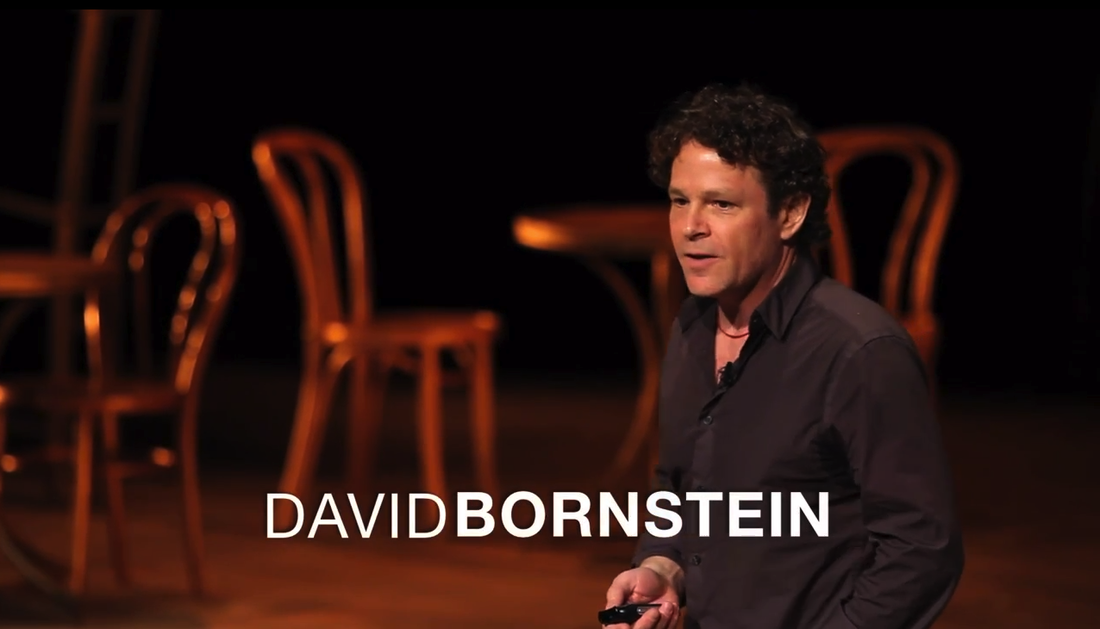
New York Times columnist David Bornstein advocates solutions journalism at a conference earlier this year.
Marquette welcomed a columnist from none other than The New York Times on Tuesday: David Bornstein. He came for the Burleigh Media Ethics Lecture, an annual event that brings in major media figures to speak about ethics.

During this year's lecture, Bornstein promoted solutions journalism, which he never explicitly defined. Solutions journalism is basically journalism that looks at ways people are solving social problems. His premise was that media overlook solutions and focus too much on the problems.

One problem I felt that the talk by Bornstein assumed we knew what solutions journalism is. The term is fairly clear, but it left some ambiguity. Bornstein clarified that solutions journalism is not fluff pieces but could meet the highest journalistic standards.

"Solution journalism" has already been tossed around a lot. Maybe we'll get a definition soon? #loweclass #muethics

— Alec Brooks (@alecbrooks) September 18, 2012
As the talk went on, I did get a good handle of what he meant by the phrase. Solutions journalism is supposed to be an objective look at places that address the problems. It can include features, like a profile of someone leading a non-profit agency. But it can also be harder news or more enterprise-style pieces.

My main concern about solutions journalism is that it could curtail critical reporting. Journalists might pass up on reporting problems altogether out of a desire to avoid writing yet another piece about how bad things are. I agree there is a bias toward problems and away from solutions, but I don't want reporters to skip important, albeit negative stories as they try and correct for it.

One thing I liked most about his presentation was a point he made at the time for questions at the end. In response to Maria Tsikalas' question about how to avoid fluff pieces, Bornstein said that when profiling someone, avoid casting them as a hero. Doing that makes readers feel disconnected from them, he said. I think that was good, specific advice. When we profile someone, we want to present them faithfully, not reduce them into a cliche.

For now, I retain some skepticism about solutions journalism. But Bornstein's talk presented a good case for it and was well worth attending. The perspective of solutions journalism is one I will add to my toolkit.

For more details, read Ryan Ellerbusch's blog post or Jacob Born's story in The Marquette Tribune. Alternatively, watch a similar talk by Bornstein at TEDxBYU.
0 Comments

What makes a good poll?

9/18/2012

0 Comments

 
Picture
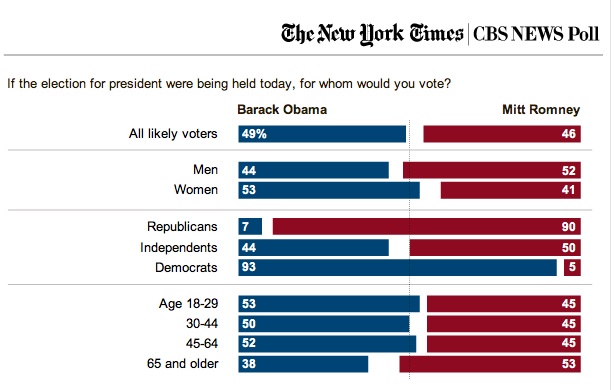
A graphic shows the levels of support for each candidate by demographic group. (Graphic by The New York Times and CBS News)
Polls are the staples of every presidential election and a useful way of gauging the mindset of voters. For Saturday's issue, the New York Times and CBS News jointly polled 1,170 registered voters from Sept. 8 to 12.

One thing I like is that the newspaper linked to a detailed summary of the questions, methodology and results. This is no doubt because they conducted the poll. They also included a detailed summary of their methods. To me, linking to primary sources is a easy way to take advantage of the web and give a more comprehensive picture.

But polls are not always accurate. To evaluate the Times and CBS's poll, I put it to a list of 20 questions (minus the irrelevant ones) from the National Council on Public Polls. While they aren't famous names, the article was written by the cofounders of the NBC/Associated Press Poll, Sheldon Gawiser and G. Evans Witt.

Who did the poll and who paid for it? The New York Times and CBS News, both respected organizations with a history of doing polls.

How many people were interviewed? 1,301 were reached and 1,170 were registered to vote — and thus able to respond. Polling that many results in a respectable margin of error of plus or minus three percent.

How were people chosen? Numbers from exchanges that served residential neighborhoods were dialed at random. Pollsters also called cell phones in order to ensure the poll was representative of all Americans.

Are the results based on the answers of all the people interviewed? Yes. All questions were directed at every respondent.

Who should have been interviewed and was not? Pollsters used multiple attempts to try and reach likely voters. They called back at different times and different days to maximize the odds of reaching someone.

When was the poll done? The attack on the American embassy happened in the middle of the polling, on Sept. 11, though most Americans wouldn't have heard about the news or adjusted their opinion on the candidates yet. The events may have had some effect on the results, but probably not a significant one, considering the 3 percent margin of error. Nate Silver explores this issue in more detail, including the advantages Obama has.

How were the interviews conducted? The survey was done by telephone — generally considered a reliable method — and was not a robo poll.

What other kinds of factors can skew poll results? Weighing was done to ensure the people asked were representative. According to the detailed summary, many questions are the same as those done in the past, suggesting they have a good track record.

In what order were the questions asked? Questions about the candidates were separate from those about specific issues, avoiding the problem of one question skewing responses to another.

What other polls have been done on this topic? A Gallup poll from Tuesday shows President Barack Obama leading Mitt Romney, 50-44, compared to the Times' 49-46. Gallup's tracking poll, which runs through Saturday, showed 48-45. So the overall results are consistent with what you'd expect.

Unsurprisingly, the poll does well on every question. The pollsters behind it have plenty of experience conducting polls, and it shows. I'm also happy that the reporting focused less on the horse race numbers — who's leading whom — and more on other findings, like that Obama's doing better on the economy.
0 Comments

Reporting on politics demands nuance, good sourcing

9/13/2012

0 Comments

 
Picture
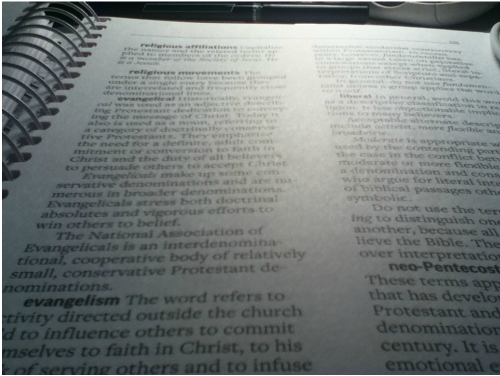
A page of religious terms from the AP Stylebook. (Photo by Alec Brooks)
One interesting aspect was how McBride divided journalism values into ones that aid religious reporting and ones that hurt. Context, accuracy, authenticity, fact-checking and nuance all help, she said, but simplicity, deadlines, brevity and conflict do not.

I'm not sure I agree entirely that "deadlines" is the best word in this situation. The problem isn't setting and sticking to reasonable deadlines, it's trying to get a story out without allowing enough time to get it right. Minor quibble aside, I liked the webinar. 

I was particularly interested in her point about knowing what terms mean because it seemed to justify all the time I spent in the AP Stylebook and on the web making sure I got the term right. Still, I realized that I didn't entirely have a good definition for the term evangelical. 

For those of you who are in a similar spot, here's the Stylebook's definition: "Historically, evangelical was used as an adjective describing Protestant dedication to conveying the message of Christ. Today it also is used as a noun, referring to a category of doctrinally conservative Protestants. They emphasize the need for a definite, adult commitment or conversion to faith in Christ and the duty of all believers to persuade others to accept Christ."

I also thought she was right to call out reporters who had repeatedly used the same source. I don't know if the problem is laziness or deadlines that don't give enough time to find better sources, but some of the examples she highlighted had pretty embarrassing sourcing. As journalists, we must do better.

0 Comments

How long will 9/11 anniversaries stay on A1?

9/11/2012

0 Comments

 
Picture
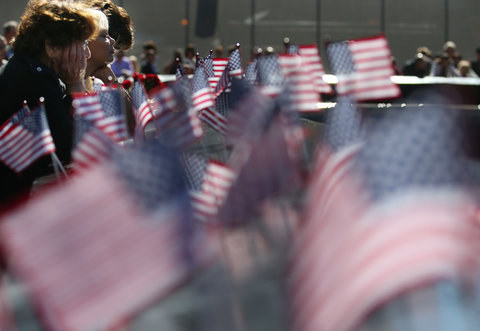
Family members of victims attend a ceremony at Ground Zero. (Photo by Chang W. Lee of The New York Times)
Today, the 11th anniversary of Sept. 11, is marked by a lull in political reporting, as the candidates honor the attack's victims instead of campaigning. As the Times reported, the candidates are making no public remarks.

Some of the released statements do suggest the political debates. Rep. Eric Cantor referenced debates over national security when he wrote, "Our national security must be a priority and we must protect against efforts that would undermine our ability to prevent or respond to another devastating attack." But Cantor's an outlier.

Interestingly, The New York Times has de-emphasized stories about 9/11 on its front page today, although they appear above the fold. I would have loved to hear the newsroom debate over where to position the box with the stories. The closest we can get is to read a blog post by The Times' public editor, Margaret Sullivan, about the paper's decisions for this year's anniversary.

The Marquette Tribune made a similar decision with today's issue. I was one of the copy editors on duty that night, and as we pored over the page in InDesign early this morning, I was struck by the fact that the national tragedy now only received a below-the-fold story. Part of the decision was because it wasn't a major anniversary  — contrast our front page a year ago — and the value of two other stories published the same day. 

In 10 years, the staff of the Tribune will made up of students too young to remember 9/11 at all and in the decades after, that will start to be true of more and more newsrooms. How will that affect how future anniversaries are reported? At some point, the stories will be even more infrequent and finally, become the domain of historians. As the Times' public editor Margaret Sullivan puts it, "The pain, the outrage, the loss — these never fade. The amount of journalism, however, must."

Ultimately, I have to agree with the amount of coverage the Times gave this year's anniversary. Perhaps the placement on the home page could have been better, but I think they set an appropriate balance.
0 Comments

Independent holds a strong lead in Maine

9/10/2012

0 Comments

 
Picture
Maine is home to an interesting race, as it features a viable independent and three candidates. However, it is not particularly contested, with leader Angus King holding over 50 percent.

One of the first things I checked was the media market in Maine. The two largest papers are The Bangor Daily News and the Portland Papers, or the Portland Press Herald and Maine Sunday Telegram.

The Telegram and Herald have an interesting politics page, which even features a Politifact-style section called Truth Test. Its format will be familiar to readers of Politifact, complete with the images of gauges that convey the degree of honesty in the claim.

At the time I looked, Truth Test featured a fact-check of an ad by the campaign of Angus King, an independent. Despite not being one of the nationally known fact-checkers, I found the article well done. It was detailed and summarized the evidence well.

Major TV news stations include WABI, Bangor's CBS affiliate.  A second is Portland's WMTW, an ABC station. This is their article about Angus King's foray into TV. Compare that to a similar story their rival WGME. Initially, I'm most impressed by WGME because their coverage seems the best and most detailed.

King was Maine's governor until 2003. He ran for both gubernatorial terms as an independent. He's generally taken Democrat-friendly stances and he's expected to join the Democrats' caucus. Officially, he's refused to say either way.

Charles Summers is the Republican nominee. He is currently the Secretary of State for Maine. Cynthia Dill is the Democratic nominee. She is currently a state senator. Her prospects are dimmest, as she's polling under 10 percent. The Washington Post published a profile of King's opponents in June.

King is leading by a 30 points, as Nate Silver recounts in this look at senate races, as he has been since June.
0 Comments

At the Times, politics doesn't rain — it pours

9/4/2012

0 Comments

 
Picture
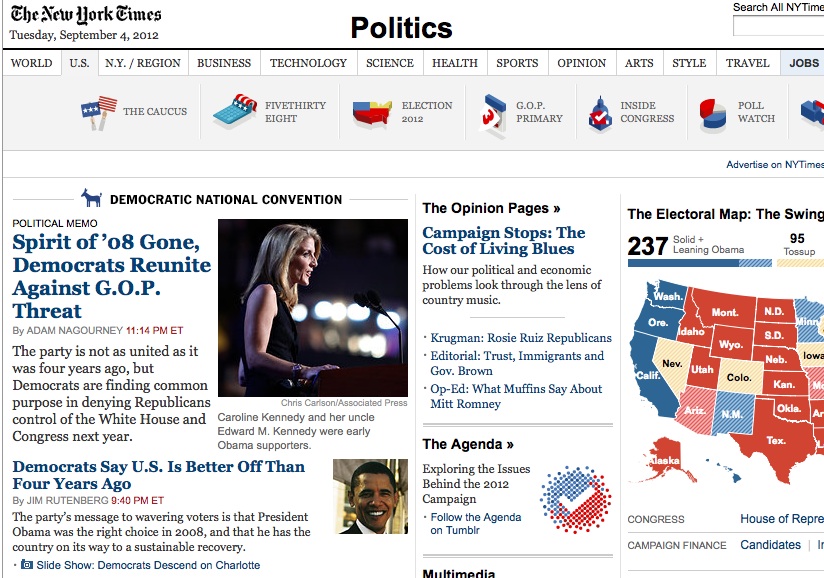
The New York Times' politics section is constantly updated. (Screenshot by Alec Brooks)
As you'd expect from a newspaper that publishes 250,000 words per Sunday edition, The New York Times has a lot to say about politics. This allows a greater variety than a smaller paper like the Milwaukee Journal Sentinel.

Perhaps the biggest challenge of blogging about the New York Times is the sheer volume of its output. The political section seems to publish something new every hour.

Sure, you have the straightforward preview of the Democratic convention. But you also have a profile of President Barack Obama that details his perfectionist streak. Michael Shear offers his advice to the Democrats as they gather in Charlotte, N.C. Nate Silver has a data-filled, historical look at how jobs numbers impact an election.

And I haven't even gotten to the opinion, like this analysis of what running for vice president will mean for Paul Ryan. Nor have I mentioned the visual features, like this electoral map or this presentation of Romney's promises.

What must be nice about working at the Times is that if the story is important enough, you and your colleagues probably cover every interesting angle. For instance, you have this piece from one of the Times' blogs that said that reporters are no longer able to keep up with the campaigns. Few papers are able to spare someone to turn the spotlight around and point it at the media.

Ultimately, I'm pleased with The New York Times' coverage. It isn't perfect, but many of the stories have an interesting spin, rather than just a repeat of what every other outlet is doing.
0 Comments

Debate moderators include veterans, new faces

9/4/2012

0 Comments

 
Picture
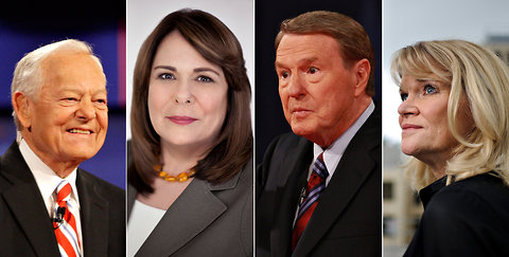
Left to right, the four moderators: Bob Schieffer, Candy Crowley, Jim Lehrer and Martha Raddatz. (Photo composite by The New York Times)
The list of moderators for the three presidential debates and lone vice-presidential debate was released a few weeks ago. Moderators include Jim Lehrer of PBS, Martha Raddatz of ABC, Candy Crowley of CNN and Bob Shieffer of CBS. (Raddatz is doing the vice-presidential debate.) NPR has a good summary of the dates and times.

The New York Times reported that the list was criticized for not being diverse enough by the National Association of Black Journalists and Univision. While one of the presidential debates has a woman moderator for the first time in 20 years, all of the moderators are white.

While Raddatz and Crowley are new, Lehrer is a veteran of 12 debates, prompting criticism that he was chosen only because he's a safe pick. Despite his experience, he was quite reluctant. He apparently only agreed to host the opening debate after the format was set to six 15-minute segments. The first two minutes will be the candidates answering question, but each segment will mostly consist of "a deeper exploration of a topic," as the Times puts it. It's an intriguing variation, and I can see why it convinced Lehrer.

The odd part is why they bothered to court Lehrer at all and not go for Gwen Ifill. She works for the same program as Lehrer did — PBS NewsHour — so it wouldn't skew the network balance, and she's moderated two vice presidential debates. Even if the debates commission had its collective heart set on Crowley, I don't think anyone would have criticized them for having too many women. Having her would also mean that one person of color was moderating.

Interestingly, the choice of Crowley may have been spurred by a petition started by three 16-year-olds, as the Times reported in a second story. The petition eventually got 100,000 signatures, though the teens weren't able to deliver it to the commission.
0 Comments

    Author

    I will examine media coverage of politics at one newspaper in particular: The New York Times. I will also include and react to insights from my classmates and professor, Herbert Lowe.

    Archives

    November 2012
    October 2012
    September 2012
    August 2012

    Categories

    All
    9/11
    Elections
    Live Blogging
    Maine Race
    Mike Gousha
    On The Issues
    Polls
    Social Media
    Wisconsin

    RSS Feed


Powered by Create your own unique website with customizable templates.